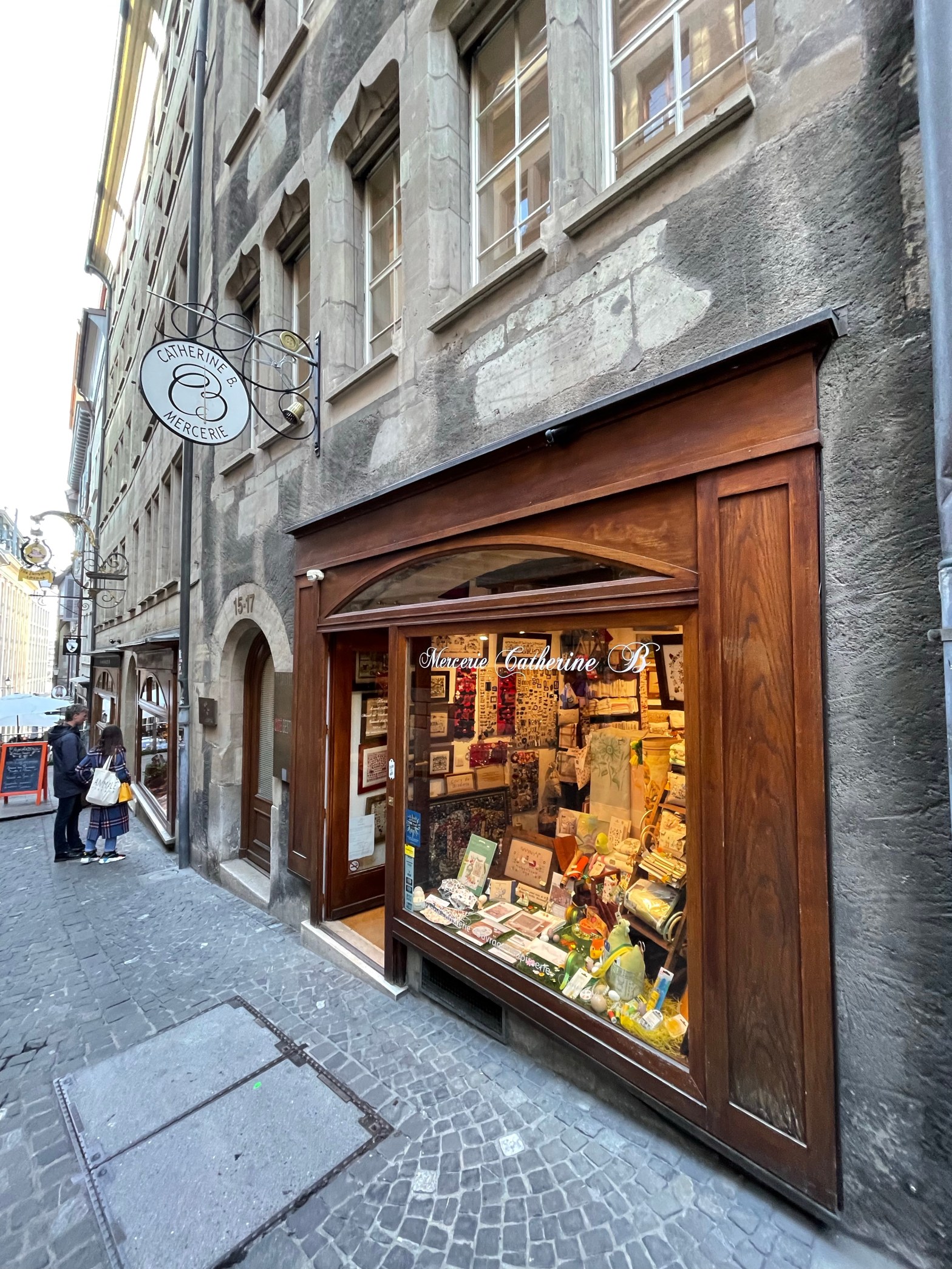
I’m not proud of this. I moved to Lausanne without knowing a bit of French.
In high school, I took a French class online for one summer. It went as well as you can imagine — I lacked the focus during vacation to devote time and brain space to learning a language on the internet. Though the only bit of info I really committed to memory was pamplemousse, I did learn a valuable lesson: learning a language solely online was not for me.
Fast forward about ten years. Jetlagged and emotional, I walked down the streets of my new city in early November, nearly crying from overwhelm. There were no English translations on the business signs lining the street. Masks were still required at the time, so that made understanding and hearing French, or even English, just a little bit harder. The man working the counter couldn’t even figure out where I was pointing on the doner kebab menu. I guess I was pointing in English.
I got back to our short-term apartment and cried, cried, cried. Couldn’t we at least have moved to a Spanish-speaking country, so I could use what little skills I had left from high school? No. We were in Switzerland and I was out of my element.
If I could go back in time, I would let 2021 me know that she should do something to learn French. Duolingo. French Netflix. Youtube. Anything to learn just a little bit more than what I came with. Which again, was nothing.
I had spent the last few months being really upbeat about taking a French class, which I had to do to get my Swiss visa since I was going to to enter the country without a job. My husband, on the other hand, had no requirement to take a French class. I was excited. I was ready to be a student again. I was focusing on putting my energy into learning a language, a languishing item on my bucket list, so as to distract me from leaving my family in a freaking pandemic.
It worked. Mostly. Until I entered the classroom of my first day at École-Club Migros and all of a sudden, the students around me began answering the teacher’s questions… in French. I knew what I signed up for — an A1 class for 5 days a week, 3 hours per day, and two rounds of 4 weeks. Was I in the wrong room? How could other students speak and understand French? Was this an actual nightmare? It felt oddly reminiscent of college, when the wrong teacher entered the correct room on the first day ever of classes and tried to teach an upper level math course, shooing away the real instructor multiple times while the rest of us looked at each other and checked our schedules nervously. (I kid you not. I live in a sitcom.)

Behind my mask, I teared up. I couldn’t understand the basic questions my teacher was asking me, much less answer them. I felt so stupid. I felt silly for thinking I could learn another language at all, much less be able to function enough to survive. All the dreams I had for learning French in Switzerland slid away — the friends I’d make! the jokes I’d tell! the florists I’d charm with my cute lil’ American accent as I’d place a brown paper-wrapped bouquet of tulips in my wicker basket, right next to the baguette and round of cheese I’d take home for lunch!
Luckily, I got my act together. Yes, I cried… and then I returned to class. Again and again. I tried other methods of learning. And one day, I did make a joke in class! A month later, the teacher complimented me on how far I’d come (and, if I’m honest, how much less intimidated I seemed). And a few weeks after that, I navigated a conversation with a pharmacist without asking if they spoke English. It was not perfect and the pharmacist was very generous, but at least I had done it.
My attitude changed pretty quickly to this: Take the win. There was no use pitying myself for the months I spent not learning French during a pandemic. (Props to the people who used that time to their advantage. I was just trying to emotionally, professionally, and physically survive. We both did the best we could.) There was no reason to point out the mistakes I made to my husband after an exchange. There was no way I was going to make my French learning experience anything other than positive, because I didn’t want it to become a chore.
Americans are notorious for not knowing another language. I wish with all my heart I would’ve made language a higher priority through college (though it still would’ve been Spanish, not French). But I was focused on other demands in my life and always thought that learning a language could happen at any time. Well, babe, that time is here and she is not waiting around for you. In the hopes that this one blog post could help any other monoglot Americans moving to Switzerland (you can do it!) or who might already be here (welcome, or should I say bienvenue) I want to share the tools I used to start my French education.
1. Jumping in with intensive language classes
My intensive class jump started my language journey. For anyone else who wants to get started quickly and has the flexibility to do so, here’s my advice: In addition to scheduling your class, make sure you have a time to study every day. Because I was not working a traditional job, my schedule allowed me to go to class in the morning, take a break for lunch and watch one episode of a TV show for a brain break, and then spend the next three hours reviewing the material I had just learned. My class moved so quickly that this was a crucial part of my process. Besides, who can learn the entire passé compose tense in one day?
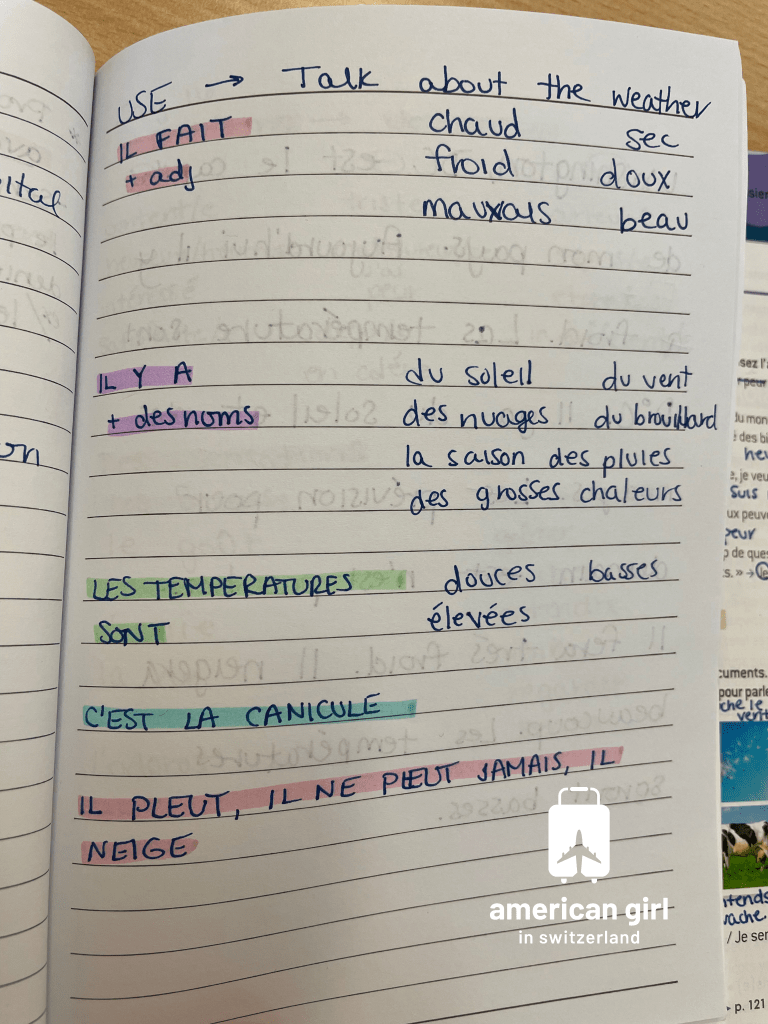
2. Getting my friends on the Duolingo Plus bandwagon
Duolingo is a great accompaniment to a class because it helps my recognition and recall, but I don’t feel that I learn a lot of new information from it. I enjoy the many different methods the app uses to get you speaking, listening, and reading. It just couldn’t be the only tool I use to learn French. To justify the subscription, I organized 5 of my friends to join my Duolingo Family Plan, bringing the yearly cost for each of us to about $20. Grab my referral link for a free week to see if it’s right for you.
3. Studying with Netflix
It feels like an expat cliché, but it’s absolutely true: Watching French TV helped my comprehension skills immensely. My preference right now is to keep the audio in the original French and turn on English subtitles. It wasn’t very easy to see immediate improvement, since listening and comprehending is not as tangible as speaking, but I was pretty excited when I started being able to recognize when the translations weren’t direct. I started with Plan Coeur (watch this if you love fun rom-coms), proceeded to Lupin (I was riveted), and then became enthralled by L’Agence.
4. Making an effort in everyday interactions
When I run out to do errands in Lausanne, I make it my mission to speak to just one person in French. Most of the time, I end up asking a store clerk where something is, which can lead to follow up questions. Though these interactions are short, they do serve important purposes: to get me speaking, accomplishing errands that I could’ve done online with Google Translate, and to build a little confidence. You can’t learn to speak a language without actually speaking it, so any attempt to talk is a step forward.
5. Living in a French speaking country
It’s not feasible for everyone who wants to learn an language to move to a country that speaks it. Or maybe it is and you just need a little kick in the pants to actually do it? I recognize my privilege in having a passport that allows me to move freely around the world, the finances to make it happen, and the time and resources I have to devote to studying. If this is an option for you, by all means, do it! Don’t wait, don’t make excuses, and just do it, because being surrounded by a different language and trying to speak it every day in most interactions beyond your apartment is, in my opinion, completely worth it.
6. Progressing with Lingoda
I’m continuing my education with Lingoda, a Zoom-based platform that allows you to work your way through their curriculum at your own pace. I’ve taken 4 classes so far and have found all the teachers to be encouraging, helpful, and engaging. In a week, I’ll start the Lingoda Sprint, a challenge they run every so often to encourage students to take 30 classes in two months with the reward of receiving 50% of the tuition back if you complete it. I need structure to keep moving forward and I’m looking forward to giving the Sprint a try! Want to join me? Tap this referral link to get 5 classes free and $50 off a Lingoda plan.
I genuinely enjoy learning French and these tools help make it part of my everyday life. I’m actually off to use Duolingo right now!
 American Girl in Switzerland